Feel like I'm clinging to a cloud
Adaptation. The first cities were prisons. Andrew & Steven. ABHOBC: Misty. Unsuitable Boys: Bruce & Danny. If you don't like it you can fuck them off too. Trump xvii: IPEO.
ITEM
“And maybe I’ll love you” - Adaptation (Nicholas Cage, Spike Jones, Charlie Kaufman, 2002)
ITEM
The first cities were prisons
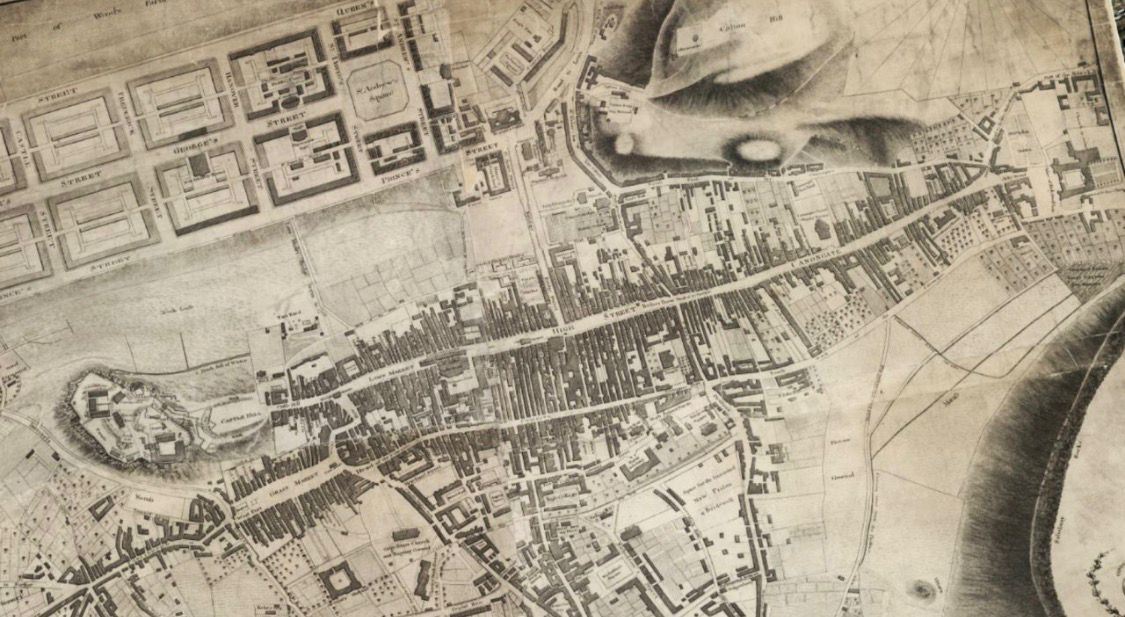
When I first saw A Plan of the City and Suburbs of Edinburgh by Alexander Kincaid, engraved by John Beugo (1784) - on LinkedIn of all places - I felt a chill. This mesmerising record of the city’s New Town expansion captured me. I couldn’t look away. It frightened me.
This extraordinary document contains, in one field of view, a whole theory of civilisation. At one end the castle perches on its rock, a fortified node of control. At the other, the raw mass of Arthur’s Seat swells into view, a reminder of a world before enclosure. Between them, the Old Town forms a dense, dark band: buildings packed along a fishbone spine, with narrow plots and closes for ribs. A city compressed to the limits of the body.
Above it the New Town appears abruptly as a pale, rectilinear grid of large, regular blocks - spacious, ordered, abstract. More like an instrument than a neighbourhood, it serves as a hinge in thought: Renaissance complexity giving way to Enlightenment legibility, the city reimagined as something that can be measured, financed, extended. In those blank fields you can already sense the coming enormity - the coming horror and pain - of the nineteenth and twentieth centuries: industrial time, speculative capital, the whole planet parcelled. Did this drawing will such a world into being?
Cities promise comfort while inventing new kinds of pain. Edgar Degas’ dancers in Hausmann’s Paris, their bodies trained into elegance, carry its marks. So too the first urban settlers at Çatalhöyük, whose shortened, strained bodies suggest that civilisation demanded more than it gave - perhaps because few ever chose it. From the beginning, the city has been a form of capture.
In this light, Kincaid’s pale grid no longer looks open, or spacious. It looks like a trap.
ITEM
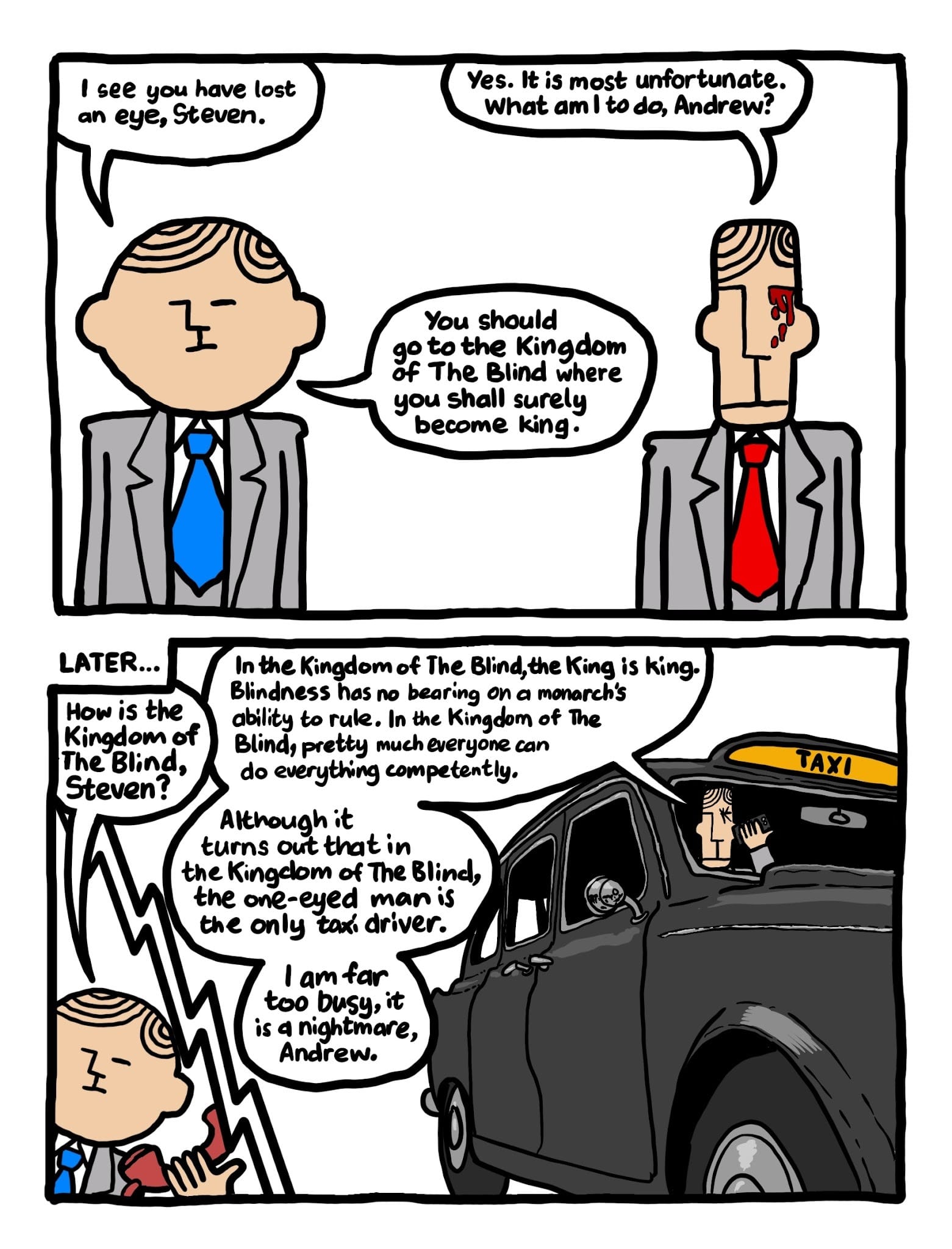
Andrew and Steven, Those Amusing Brothers
ITEM
Sacred item pressed against my lips
Tell just one person that you liked this newsletter. Word of mouth, more than any other form of promotion, is how creative works get noticed and sustain themselves. Thank you very much for reading.
ITEM
A Brief History of British Comics~
22: Misty
- Publisher – Fleetway
- Feb 1978 – Jan 1980
- 101 issues
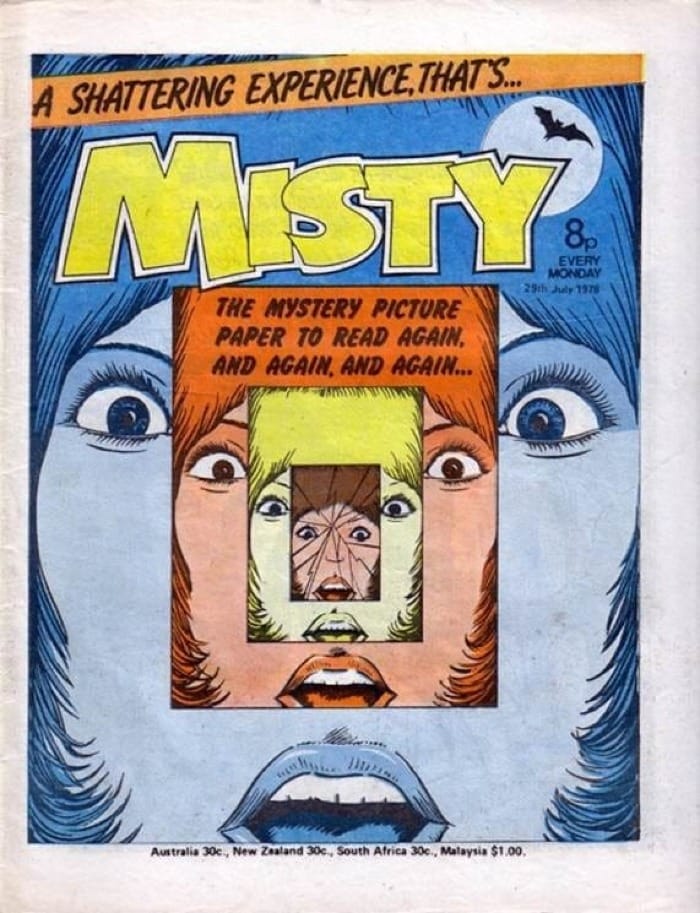
This is the Secret History.
Paint It Black. The Sentinels. House of Faith. The Salamander Girl. Napoleon Comes Home. The Swarm. The Changeling. The Love and the Laughter. Avalado’s Portrait. The Guardian Lynxes. Slave of Time. The Purple Emperor.
Telepathic teenagers and psychically manipulative swimming teachers. Pig-worshipping cults and pop music that wakes the dead. Brutal correctional schools and malevolent mirrors. Time travelling tower blocks and haunted ballet shoes.
Dark Secrets, Dark Nights. Let Not Evil Flourish. Web of Lies. Was it Just…A Game? Count The Flowers. Vengeance is Green. The School of the Lost. The Staircase to Nowhere. Poor Jenny. The Bell Jar.
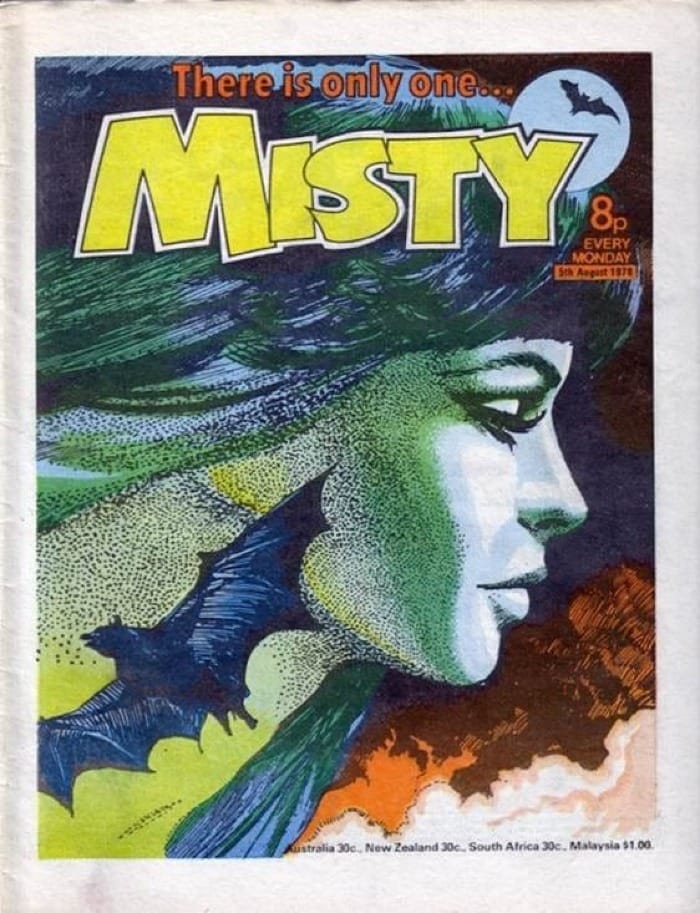
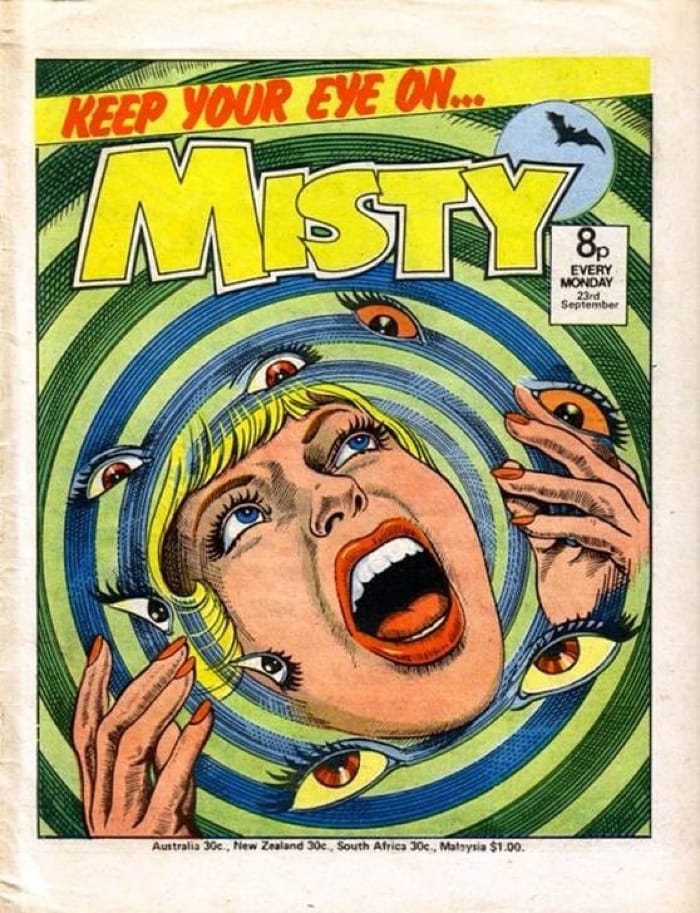
Under the haunting, ethereal penwork of Shirley Bellwood’s covers, pages seethed with gothic intensity and high English weirdness. Twisted romance, bitterly wreaked revenge and cosmic comeuppances, filtered through the bleak lens of 1970s Britain. Children suffering, adults untrustworthy and uncaring. Tear-streaked cheeks.
When The Lights Go Out! Skullduggery. Mrs Barlow’s Lodger. Seal of Secrecy. Alien Seed. In a Broken Dream. Fingers of Fear. The Day the Sky Grew Dark. The Wrong Station. The Four Faces of Eve. When The Rain Falls…
Perfectly pitched overwrought melodrama and phantasmagorical twists in the tale. Black and white fever dreams snuck into schoolbags graffitied with the names of teen idols, and read illicitly during double geography on a rainy Wednesday.
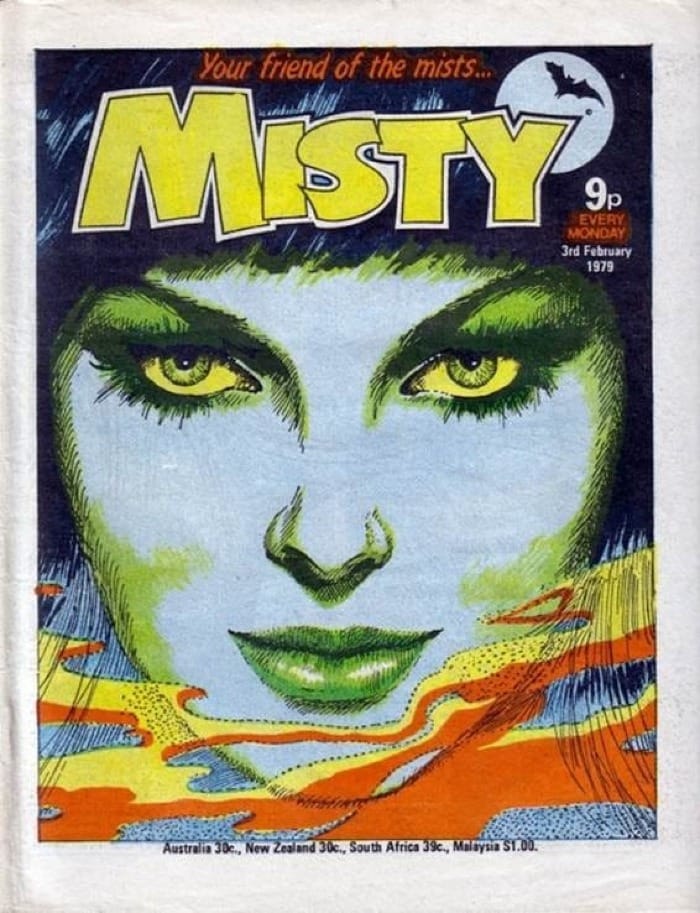
Watch Your Step! Song of Petina. Safe Until Morning. What’s on the Other Side? Dance of Death. Ratcatcher. The Visitors. The Jukebox. Hold Tight Please! Doorway to Yesterday. Lift To Limbo. The Ever Open Door. The Queen’s Hair. Hush, Hush Sweet Rachel. Voices In the Wind.
It was right there, all along. Waiting for us in the shadows. As vital a part of the weird pop-cultural 1970s landscape as Dr Who, Children of the Stones, or Worzel Gummidge.
Never forget.
ITEM
Unsuitable Boys: Bruce and Danny
Blue Jeans No. 272
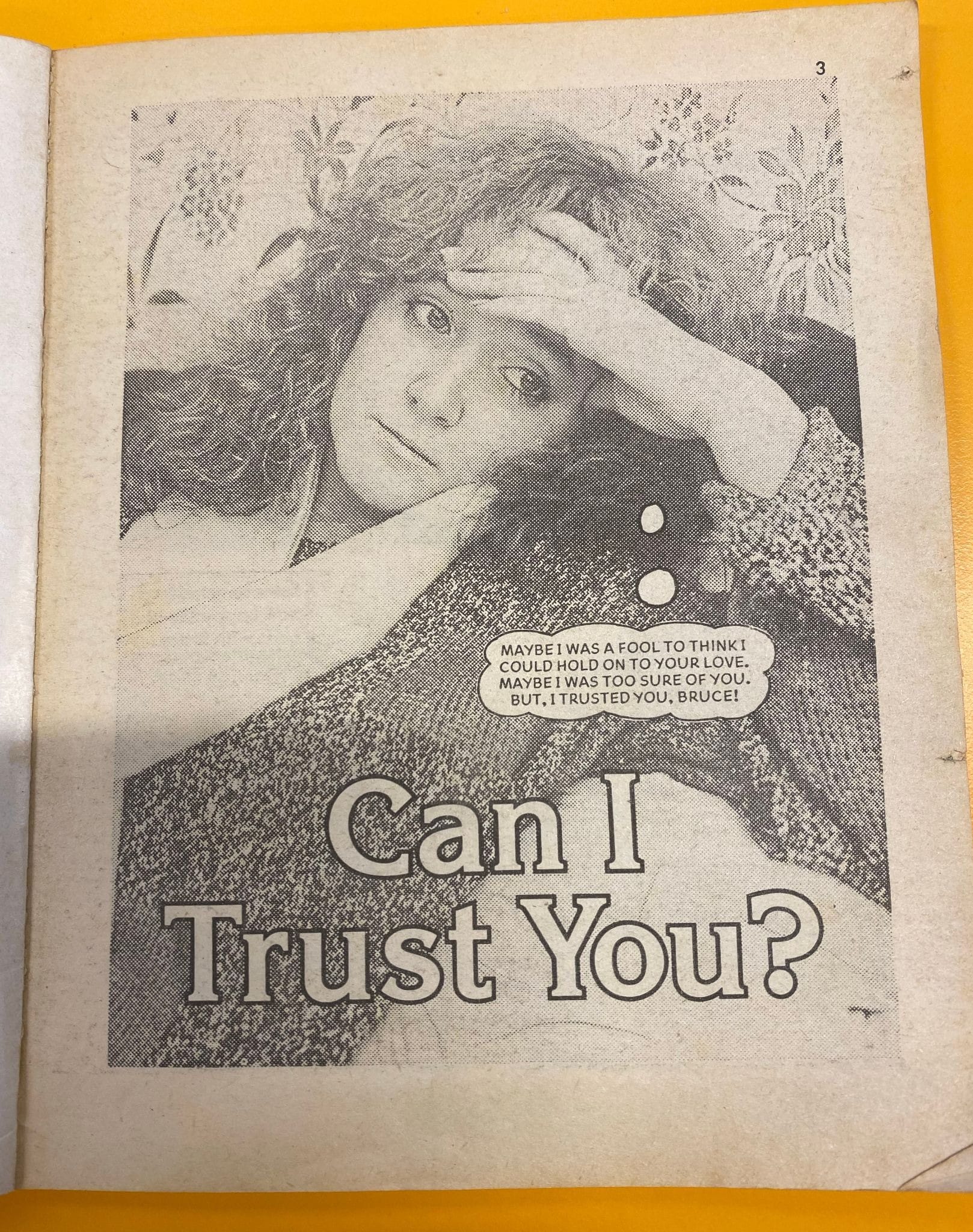
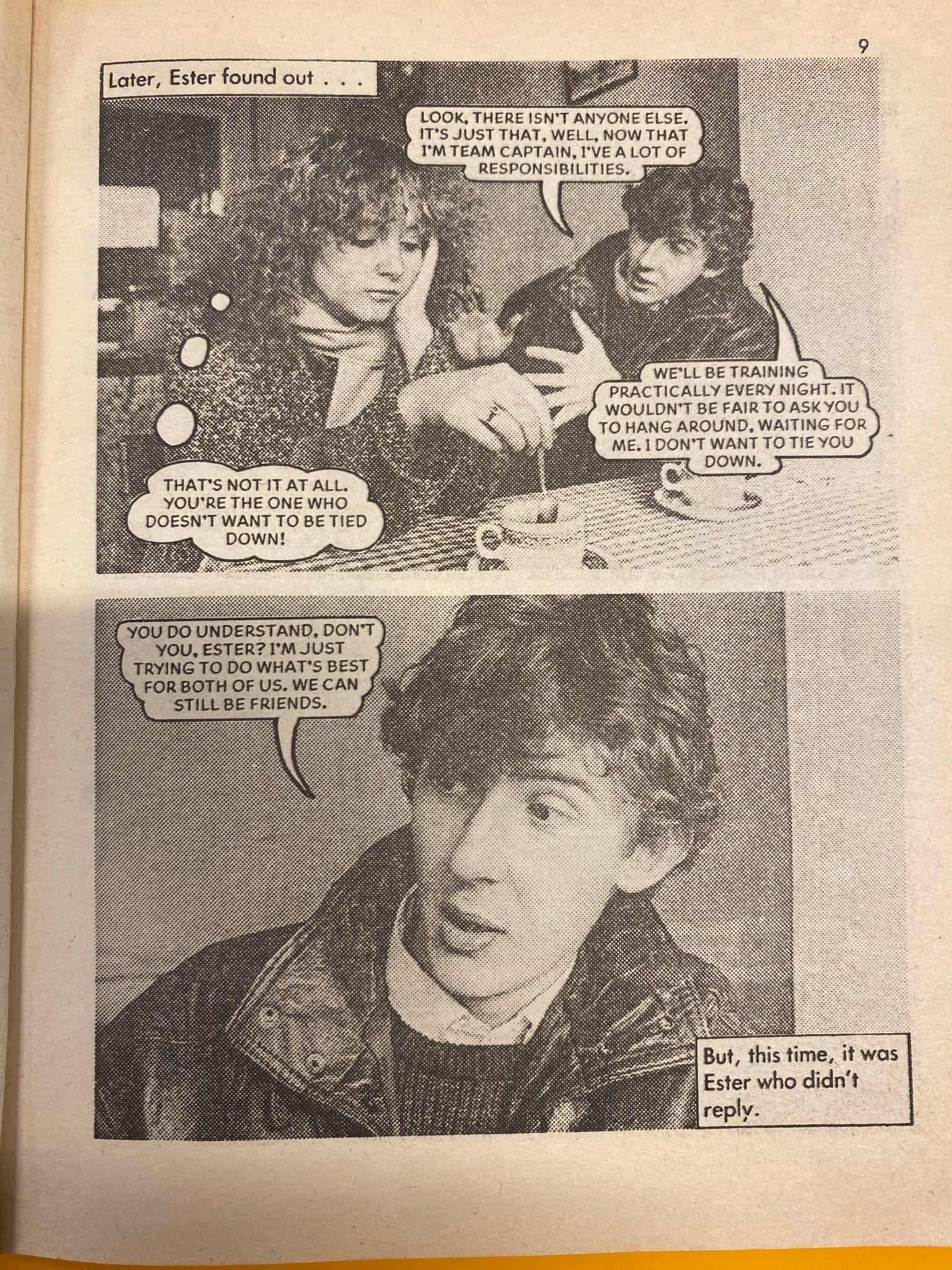
Bruce, a man who definitely lets his beans spread over the plate to touch his egg and his chips, does not know when he’s well off. Having gotten a girl he wants more. Non-specific. The biggest fish in the smallest pond his fame as captain of the school team gives him aura and an appreciative audience who inexplicably find his guttural utterances charming. He hungers. Not for a relationship, not for relationships, no matter how fleeting, but for the adulation of a crowd, a mass attraction that doesn’t need consummating to be powerful. He bins Ester off with bean juice excuses, his responsibilities as team captain, the rigorous demands of training, and moves her to that unsatisfying raggedy status of ‘just being friends’.
Avoiding Bruce and the humiliation of a playground swimming in gossip about her life Ester bumps into Danny, new student with a secret. Danny, a man who sacrifices some of his chips constructing a dam to keep the beans at bay.
Bruce takes umbrage. His ego may be a bit needled by how quickly Ester has moved on but you know he wouldn’t give a damn if Danny wasn’t better at football than him. Ester suddenly becomes desirable again, not for herself but as a proxy for all the other girls whose attention is now switched to the new boy.
Bruce uncovers the dark secret, accusation of theft, stolen objects conveniently found in his pockets, a frame up job. A trivial matter for Bruce to copy, trapping Danny in a repetitive loop. Danny withdraws but Bruce’s plan doesn’t work, Ester still wants him.
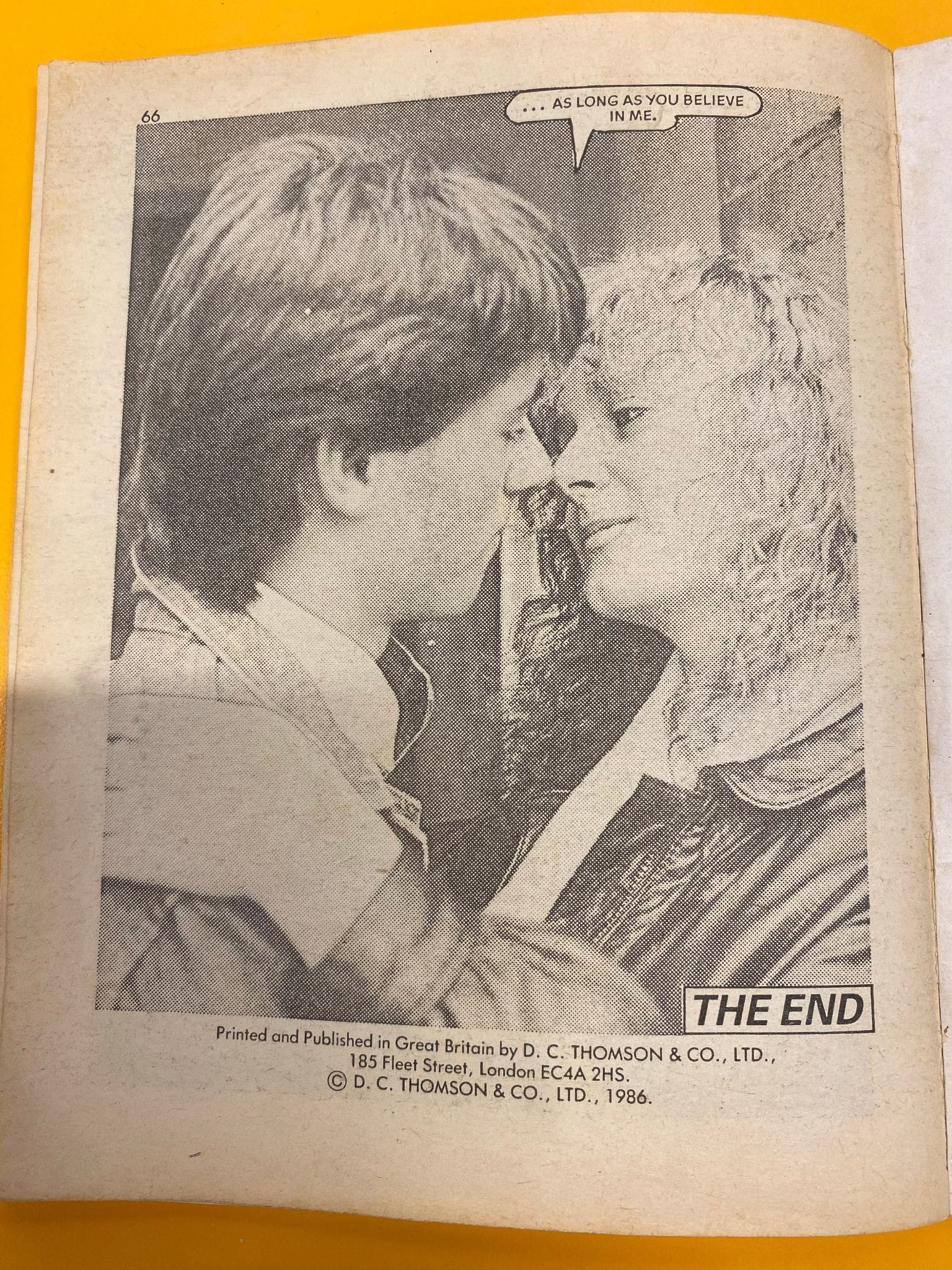
Danny’s unsuitability is his passivity in the face of life, his willingness to run away and his hangdog embrace of his victim status. False accusations will accrete around him till Ester finds her role as confidant, sole believer and defender mutating from charming to exhausting.
ITEM
IF YOU DON’T LIKE IT YOU CAN FUCK THEM OFF, TOO
I think my best cultural moment of the week, as loath as I am to advertise for or credit the four billionaire streaming channels I presently subscribe to, was probably The Boys s5e05 - it’s always nice like that heist ep of The Mandalorian or the fly in Breaking Bad when it feels like TV writers have bothered to do some clever structural stuff which will go underappreciated, because that’s serial media baby!
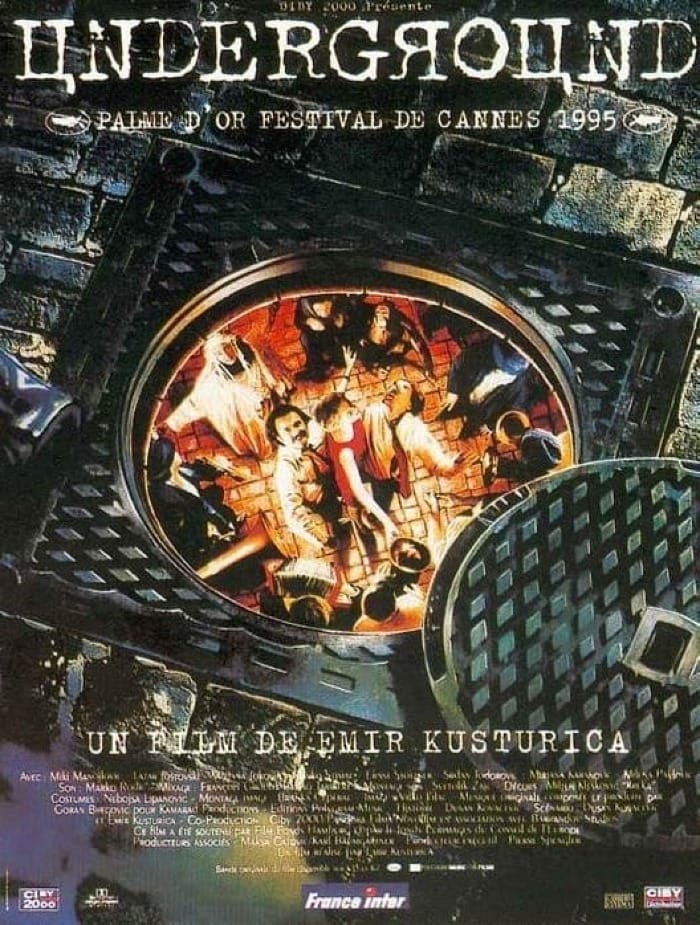
Anyway Seth Rogen and them all get massacred, Aziz Ansari, and it sort of serves as a critique of The Studio (easily the most self-congratulatory, appalling shit I have seen in years) and Eternals (“I’m yoked now!”) and all that, as well as its well-worn target of liberal handwringing which is only secondary to the bald-faced satire of the American right. In short it’s a Garth Ennis comic, only it isn’t… but really it is and probably about as key a text as you might hope/despair to find for 2026 era. Every other show on these channels seems to be some divide and conquer post Atlas Shrugged fantasy in the line of - but not, because it’s too good - Emir Kusturica’s Underground about the literal balkanization of Yugoslavia, and some are okay but it’s a bit sick innit. Something something, satire is propagatory and instantiating, and you’re as well or better creosoting a fence (~ Steve Aylett/Alan Shearer)
WHAT MAKES YOU THINK, THAT I CAN’T STILL LOVE YOU
Music this week is the excellent u, by underscores, sometime Danny Brown collaborators - don’t worry readers, I made sure it connected back to rap! This is pretty light and well constructed glitch-pop, a detuned radio playing The 1975, MUNA/Sistra (same band effectively) & Ninjairachi. I have no idea where they are from and won’t look, hopefully New Zealand?
YOU GOTTA TELL ME YOU WANT IT
ITEM
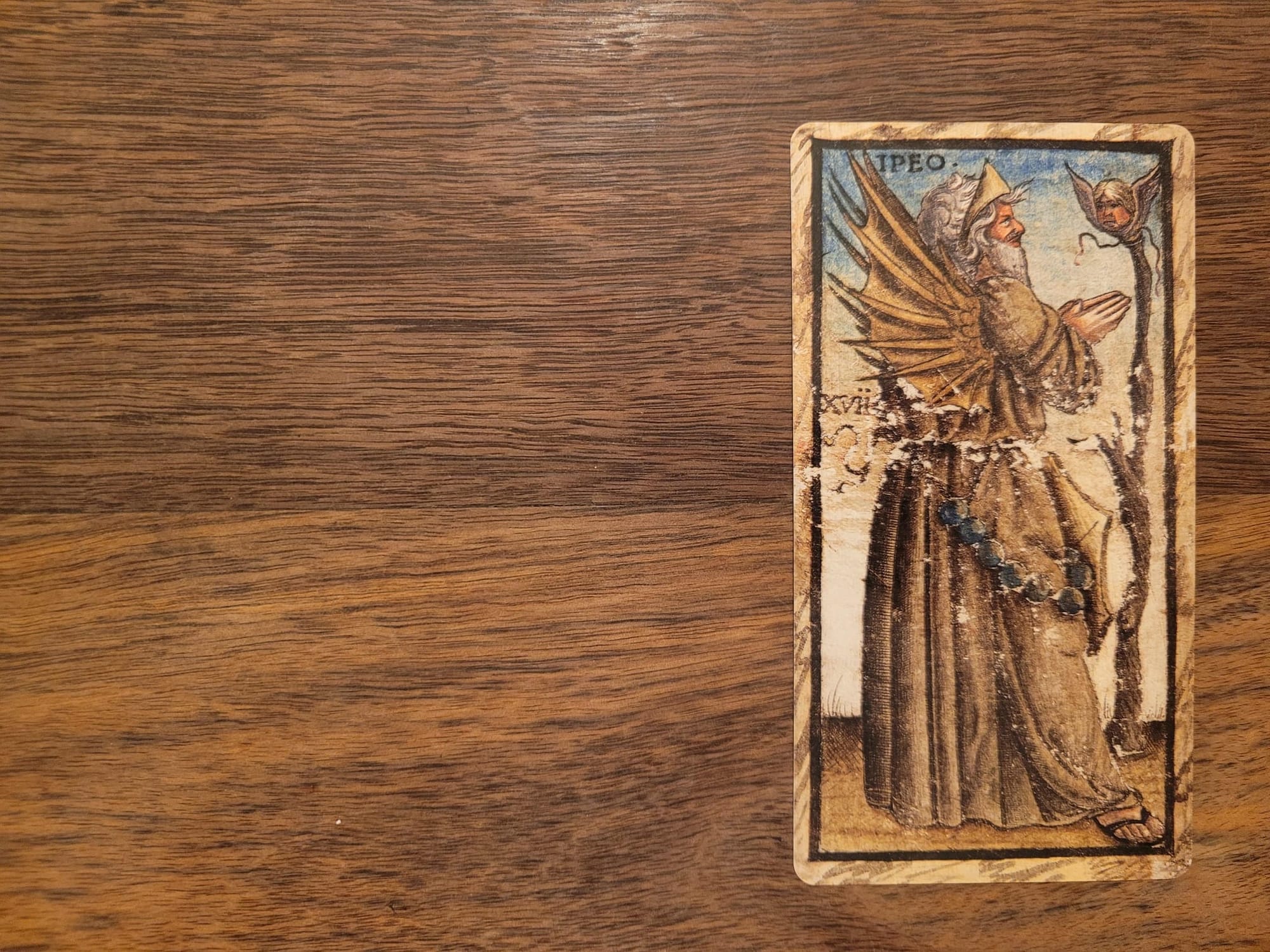
Trump xvii IPEO
Sola-Busca Tarot (Author unknown, 1491. Reprinted Lo Scarabeo, 2019)
A compression of unstable data which, decoded, undoes the world. Designed by a cabal of mercenary curse-makers in exile from falling Byzantium, then held in secret by Europe’s warlord aristocracy for four hundred years, it broke momentary cover at the British Museum in 1907. City tripping from her girlfriend’s place in Winchelsea, Pixie Coleman Smith catches the exhibition and sketches certain designs, injecting them into the world through her own tarot deck two years later.
The Sola-Busca falls back into the shadows until the 21st century. Why it chose this era to emerge is a question of some disquiet.
Interpretations of its imagery and purpose vary, but most urgent, upon even fleeting contact with the cards, biting your fingers, is that the tarocchi is a talisman of attack magic: an elaborate device for turning men into dragons. For communing with the antihuman demiurge.
Delighted by misery like a cat loves a spider, the deck seethes with menace and only tells bad futures. Card after card turn with the fascination of a bad dream, interrupting human bodies by the abrupt, invasive presence of material objects. Ranks of batons assembled to pierce organs and take territory. Clusters of coins forced into hoards by impious cherubs. Cups laced with poison. Swords gripped in absent fury as a madman clutches his dick. Its illustrations of spiritual energy states and dark-hermetic abstractions point towards the boot codes of the industrial age: clocks, weights, measures, the backbreaking toil of transforming nature into power through fire and child murder.
In trump seventeen, where a star should be, stands Hippias of Elis. A sophist who taught the ruling classes to recognise each other and practise solidarity against their own, he stands in a monk’s robe and snakewings, praying to a dead tree that manifests the insane face of the cosmic angel, promising immortality with simple instructions: make a hell of earth, and keep it that way.