We are someone else's property
ITEM
A Brief History of British Comics
25: Action
Publisher – IPC Magazines
14 February 1975 - 5 November 1977
86 issues
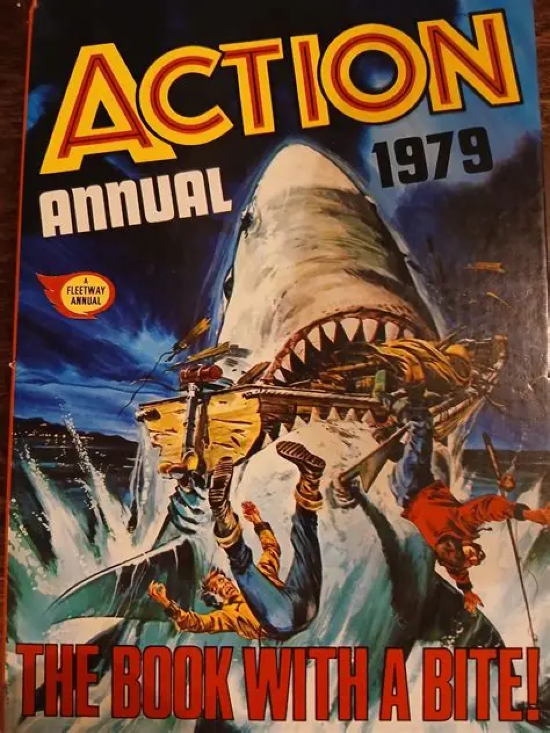
It was the glinting lights of the town in the distance that did it. Those tiny signifiers of civilisation, of humanity. Of dry land. That was what really nailed the despair. Why would you go fishing at night, in a boat that small? Perhaps it was drunken bravado, a fraternal ritual. Perhaps it was necessity. Livings eked out on the edge of the yawning ocean.
It was the size of the shark. Bursting up from the icy nighttime depths, destroying the fragile vessel in one bite. A monster, pale and dead-eyed; a ragged maw full of razors. The end of a harpoon jutting out below, a gnarly trophy of its indestructibility.
It was the plummeting figures, caught moments before their inevitable death. A death of thrashing, tearing trauma. Of frothing blood and brine, and the long cold embrace of the sea. The panicked faces of these foolish smalltown fishermen, as they realise their final mistake; thinking they could be the masters of the black waves that they now hurtled towards.
It was the cover of the 1979 Action annual. It was my brother’s Christmas present, and I, barely out of toddlerhood, would stare at it with rapt, appalled transfixion.
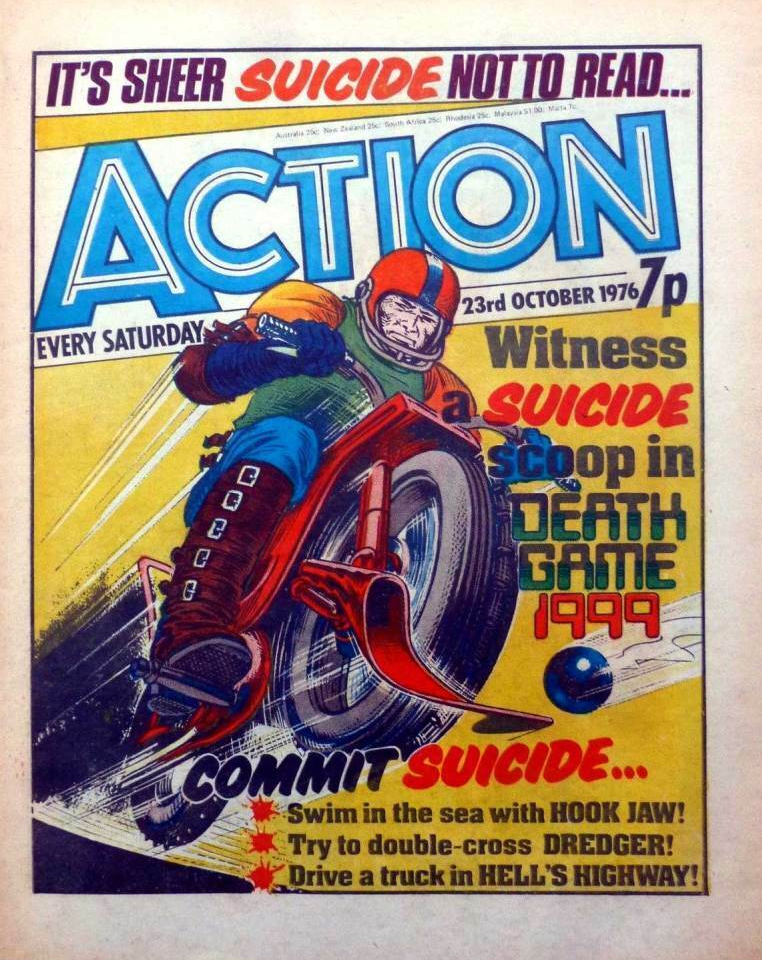
Action was a core renegade text of the 1970s. A playground provocation that understood the grisly fascinations of kids, and weaponised them to thrilling effect.
Under the firm steer of Pat Mills, the strips riffed on exploitation films of the time. Smudged-ink pirate-copies of adult films that kids weren’t allowed to watch.
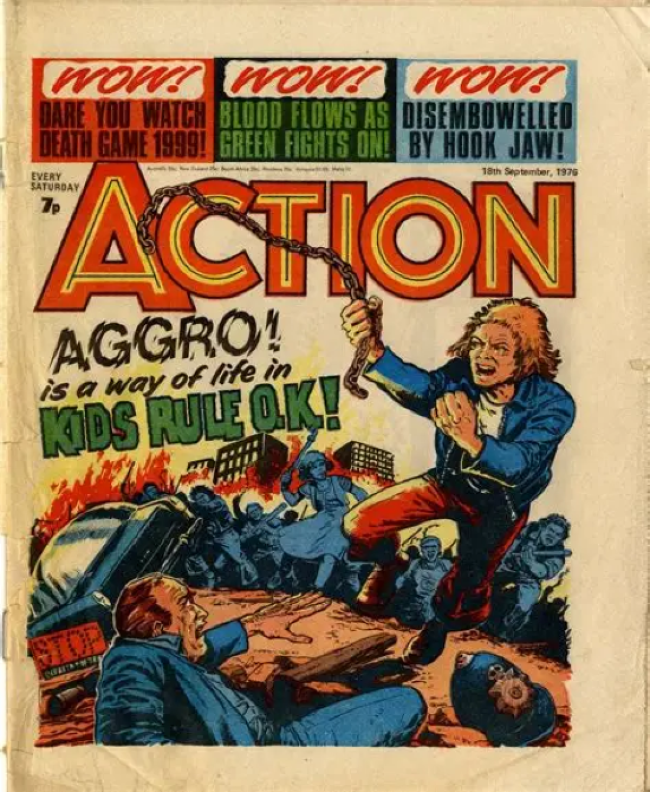
‘Death Game 1999’ was a Second Division ‘Rollerball’
‘Dredger’ a grotty British spin on ‘Dirty Harry’
‘Blackjack’ was ‘Rocky’, but righteously black.
‘Hookjaw’ was ‘Jaws’ with the shark as malevolent anti-hero.
It was grimy and riotous. It got in the tabloids and got banned.
It was necessary.
ITEM
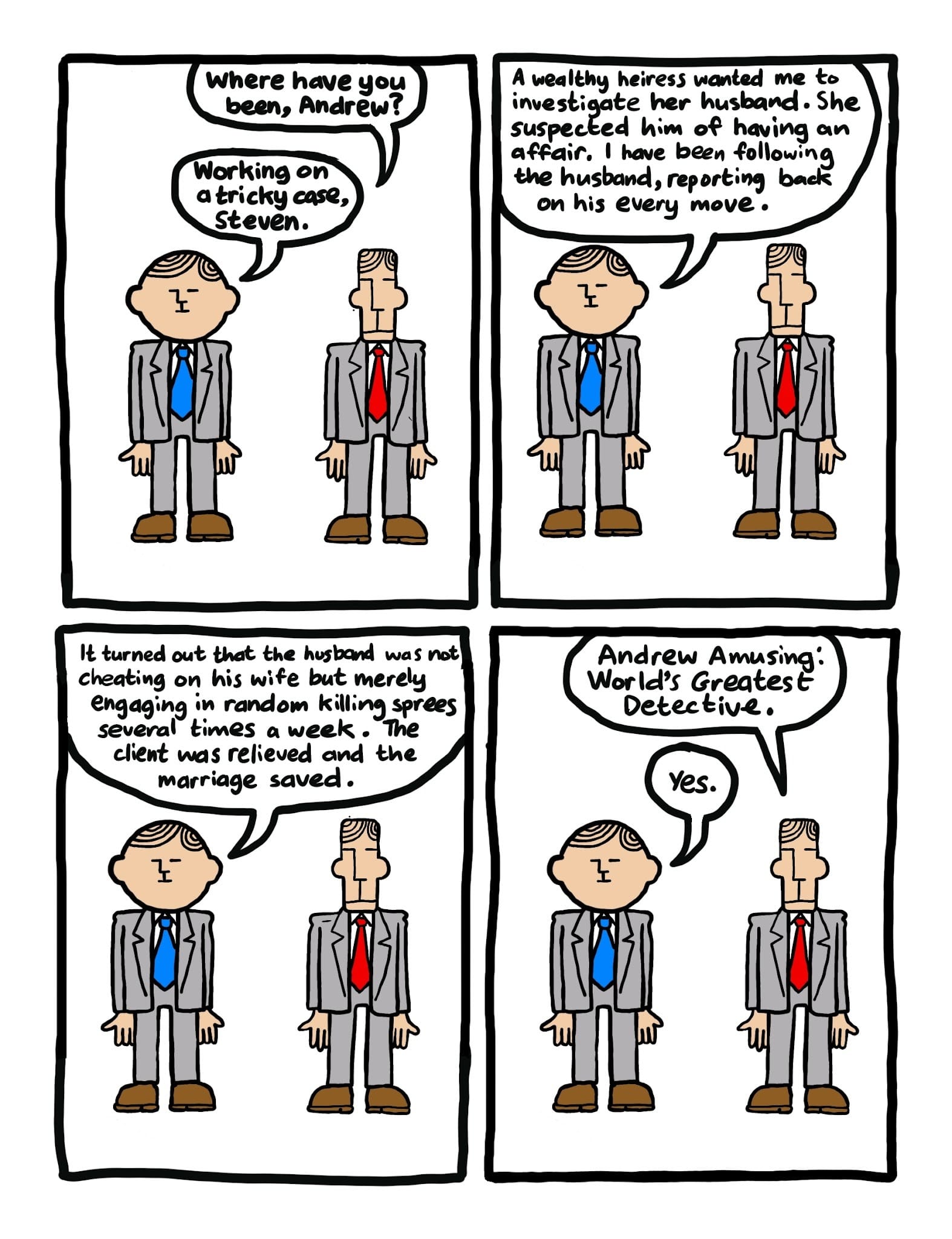
Andrew and Steven, Those Amusing Brothers
ITEM
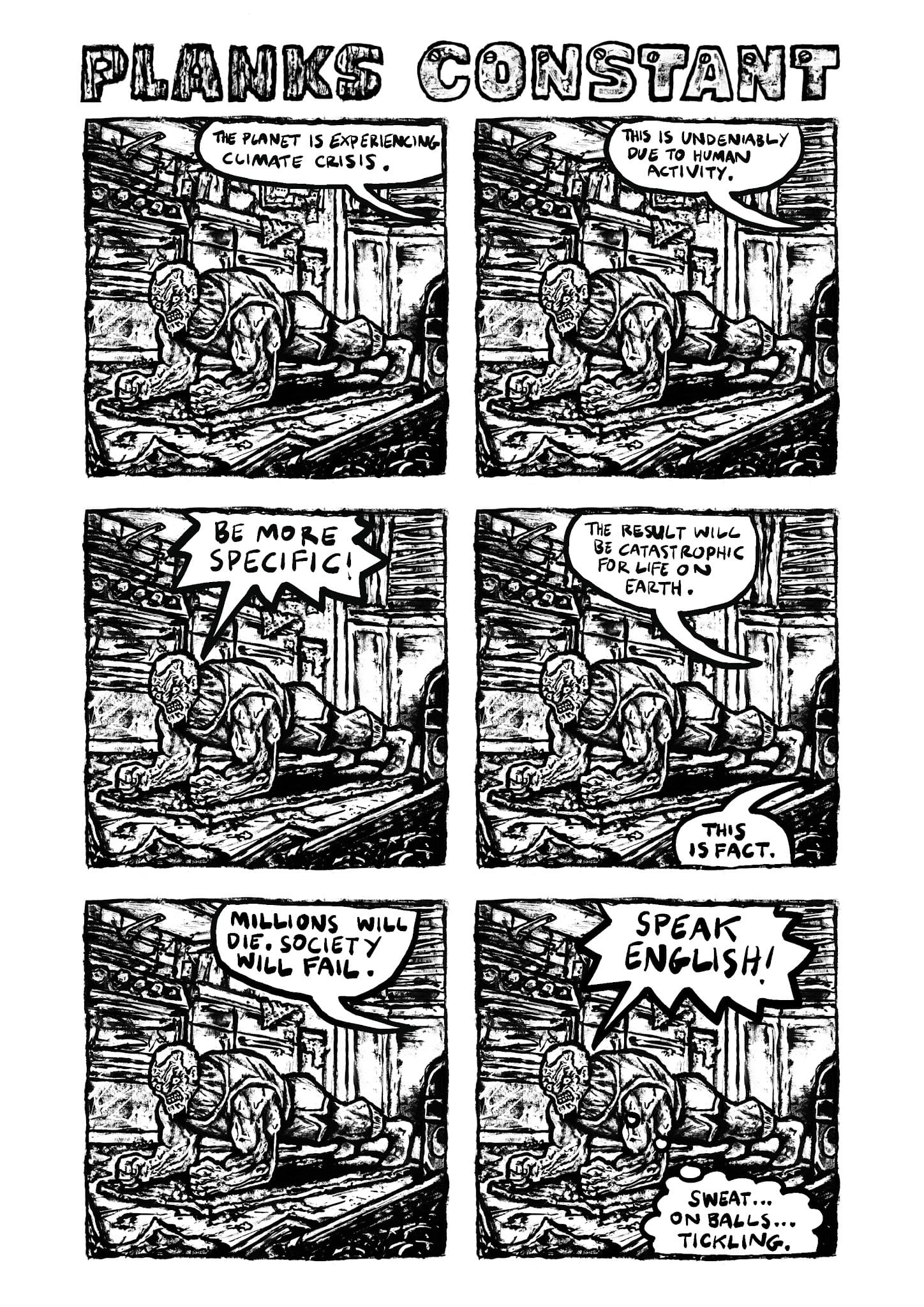
Planks Constant
ITEM
“Did James Corden Lose His Temper at British Airways Representative?” – Millennium People (J.G. Ballard, 2003)
Question: since our would-be tech lords are regressives whose futures are only for investors, does this mean their stale sci-fi affectations are just aids for limited imaginations? Not quite. Instead, their layered nostalgia contains signals within signals for the market. So colonial gestures towards Mars are a demand to make working conditions more dangerous on earth, talk of social media as town square is a scrabble to build new broadcast monopolies, and AI’s good life dreams are a threat to bring factory automation to the home office.
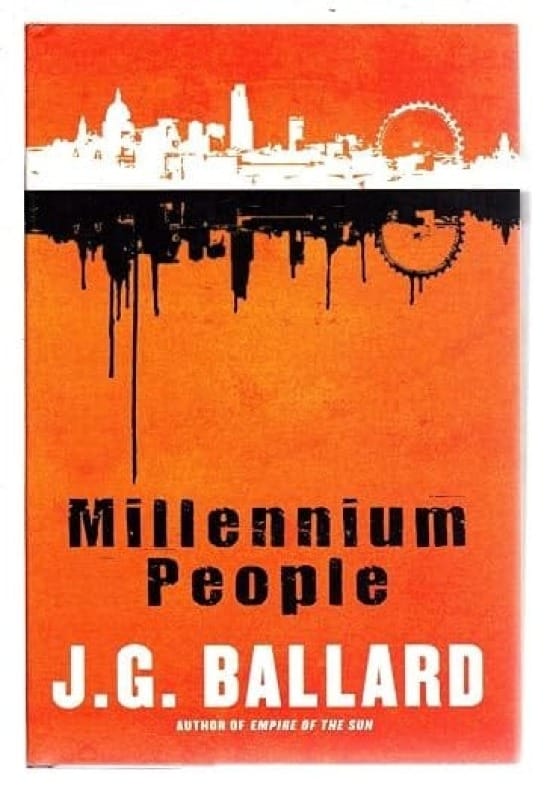
In his last run of novels J.G. Ballard had his eye on where the denizens of offices and lecture halls might turn when their future was in the past. Kingdom Come’s suburban fascism has been the more compelling reference in recent years, and it’s tempting to find Millennium People’s vision of a cohort waging war on the symbols of its own status quaint in comparison. In 2026 is the Tate Modern truly Disney for the middle classes or is that role officially occupied by Disney itself?
There’s also an irony in the novel’s analysis of a world clinging to dreams made for the previous century. For all its catchy barbs and semi-contemporary references to the Jill Dando murder there’s not much in Millennium People that wasn’t there in compressed form in High Rise (1975): “Their real opponent was not the hierarchy of residents in the heights far above them, but the image of the building in their own minds.”
Still, maybe it’s useful to update these worn prophecies. Think of the way AI provides both a belated language for the religious aspects of the economy and a new hook for the beleaguered professional: this time you can actually talk to the manager (god).
Whether thwarted souls will turn the altar of the customer service desk into a war zone remains to be seen, but we can guess where Ballard’s money would have been.
ITEM
Forteana
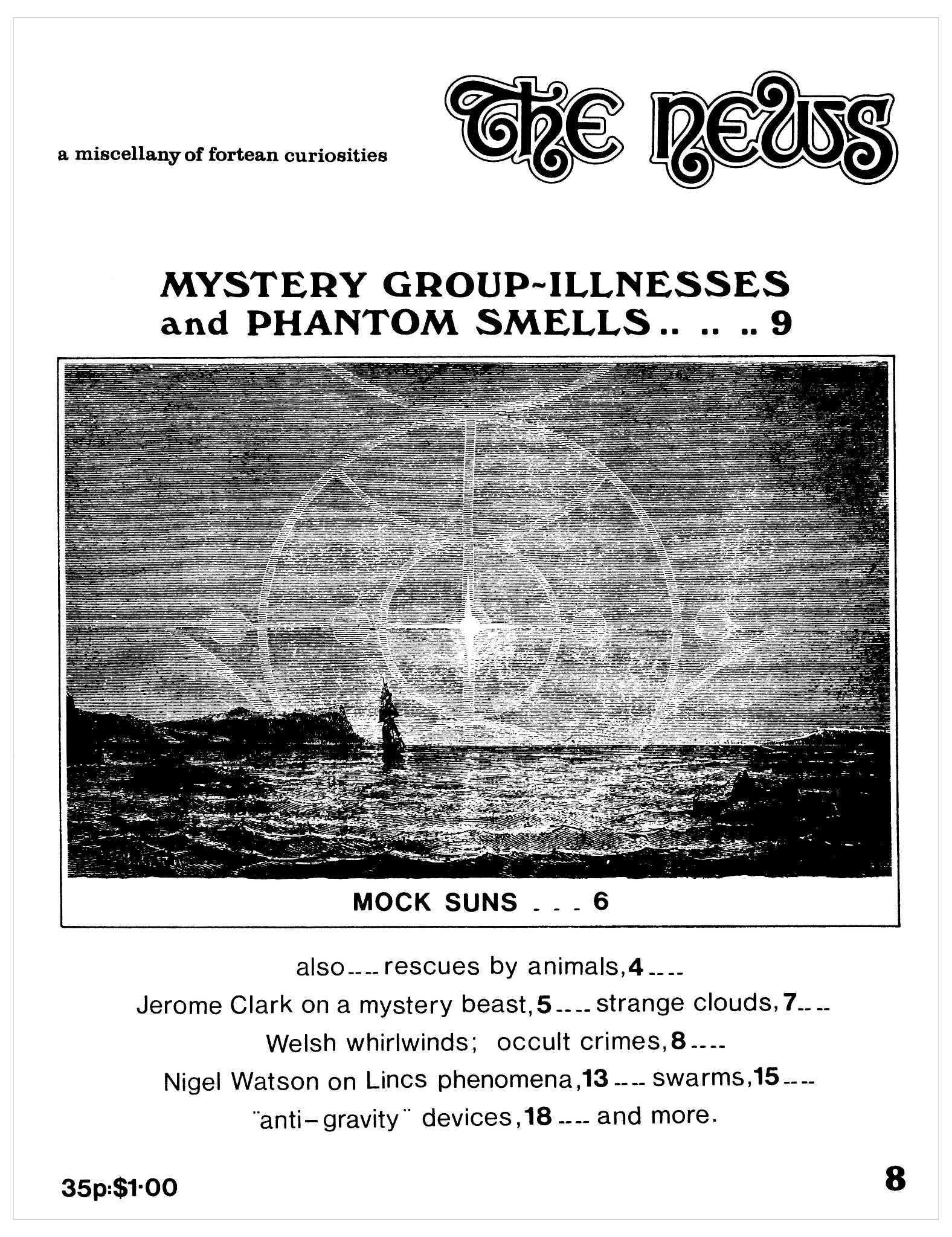
There’s not much talk of forteana in today’s disclosure flavoured “unexplained” discourse. This got me thinking about the feel of the fortean - its qualities as an aesthetic category, and what we could gain by unearthing it.
At risk of making a distinction without a difference, the fortean strikes me as a specific kind of hauntology. The standard construction is of course “the past inside the present” or some variation, but haunting abides in other dualities, where something excluded - most often deemed dead/forbidden - insists. This is much like Charle’s Fort’s (1874-1932) category of the “damned”, into which he assigned the anomalous phenomena that he famously recorded.
Unlike the ghost which hardbakes absence into its form, the fortean realm is much more vivid, even vigorous. Fort emulated, with a degree of irony, the scholarly modes of the 19th century, inventing vast taxonomies of unexplained phenomena (and contradictory explanatory hypotheses) whose myriad reported occurrences he catalogued in much the same way that a naturalist might catalogue weather.
Central to this was a desire to show how much is excluded from the scientific account, and the porous, strange edges of any system of categorisation. The damned will always return, because they were never properly cast down in the first place. The fortean contains moon shadows and wheels of light and timeslips and blizzards of snails. Nothing is as simple or stable as an alien craft or a spirit returned from the dead.
There’s generalised strangeness to the fortean that treats unexplained and explained phenomena as equally weird, but in a way that’s distinct in tone and content from the conspiracy theorist’s relentless para-speculation, with their claims to zetetic knowledge, and ideal of coherent story-crafting. The fortean is, by contrast, multiplicitous and inherently unsettled, a sea of strangeness at the edge of the world that must stay unadmitted, lest it lose its quality.
More anon.
ITEM
Summer Fun: Order
Van loaded with black magic tat and drugs Rich and I are headed into the countryside to do big ritual magic. Our plans are derailed slightly by crashing into a police detective. Serious Crime. On a job tailing a suspect. He goes back to his wrecked vehicle to call it in. We watch wondering how much shit we are about to be in. A voice behind us says “Can I help?’ we don’t even turn around. ‘Nah, we’re alright mate’
‘No’ says the voice ‘You don’t understand, I’m a policeman’. We look round. He is. Half in uniform. For reasons best known to himself he has been getting changed from the boot of his car in the garage forecourt.
Maybe everyone is policemen? Maybe we are policemen? No. We are not policemen.
Things happen. Fire engines sail in. Two squad cars arrive with various important ranks. Outside of breathalysers and a cursory ‘What happened?’ they ignore us. Most of the talk is between themselves. We stand there waiting for the kicker.
‘You won’t do that again will you?’ says the Inspector, and we are free to go.
It makes sense. It’s not like telly. You can follow someone with three cars, but they prefer five, we haven’t busted the operation. The car is solved with insurance and auction. The policeman achieves the dream of whiplash and paid sick. And no one has to go and knock on anyone’s door and deliver the worst news. If you are going to be in a car crash I highly recommend hitting a professional.
There’s still the small matter of destroying the work van. We call Rob. If you want to imagine Rob he looks exactly like Penfold from Danger Mouse and because he works in pubs is reminded of this daily. Consequently he veers between being a sweetheart and an absolute dick. We tell him we’ve totalled the van. ‘Oh it was a piece of shit, we needed a new one anyway. Do you want a lift?’
ITEM
Crop circle
Tell just one person that you liked this newsletter. Word of mouth, more than any other form of promotion, is how creative works get noticed and sustain themselves. Thank you very much for reading.
ITEM
A BRIDGE, OR PIER, INDISTINCT HORIZON HAZING
Metal Gear 2 is ridiculous, one of these things like Twin Peaks that are actually the literal best but you have to heavily caveat (half of TP is basically rubbish, MGS2 you play 90% of it in search of the actual good protagonist with one of games’ most hated leads - is it the best game, yes it is the best game, despite handicapping itself thus).
Mind Burial, mind hauntology? It’s back, in pog form.
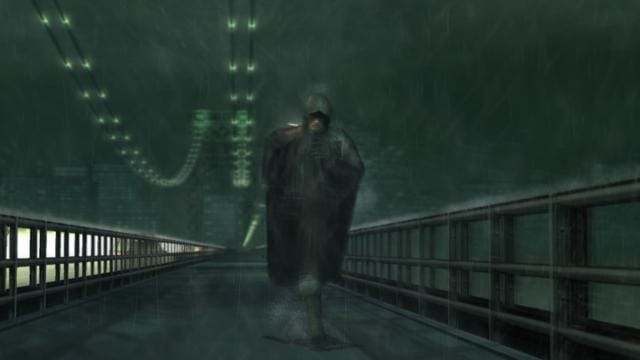
I about lost my mind when I recognised the Burial drum patterns in the new Kelela & PinkPantheress joint - my young Bulgarian colleague who was my favourite and has since, much to my chagrin, departed described PP as “my Princess Di” and I can only assent to this judgment; what a producer, what an archivist - the ghost of Metal Gear adumbrates this love song: “it’s kind of, like, dark” [shell casing falls - Hideo Kojima and Hayao Miyazaki both have an interesting relationship with war hardware for pacifists eh] and it has sent me, like Raiden there is away to, aff the bridge.
& I washed up on The Beach in Death Stranding? >>unsure<< faint sound of All Saints ‘Pure Shores’, which you suddenly remember had an absolutely sensational b-side, the best thing they ever did, in the distance
Speaking to another colleague about leaving she described her anxieties in very Severance liminality language, being no-clipped from elevator to room, it got me thinking about these numinous spaces again - I need to see Backrooms, the new Spidey has just enough flavour of this from the aforementioned Sev and Stranger Things - which everyone is familiar with yet are only ever experienced in solitude, internally, the sharing is only in relaying; one space, everyone knows it but asynchronously, is also basically the Death Stranding play experience, you might find an echo of someone. Any first person narrative, really.
Transition space, the motorway cafe is the most transitional space.
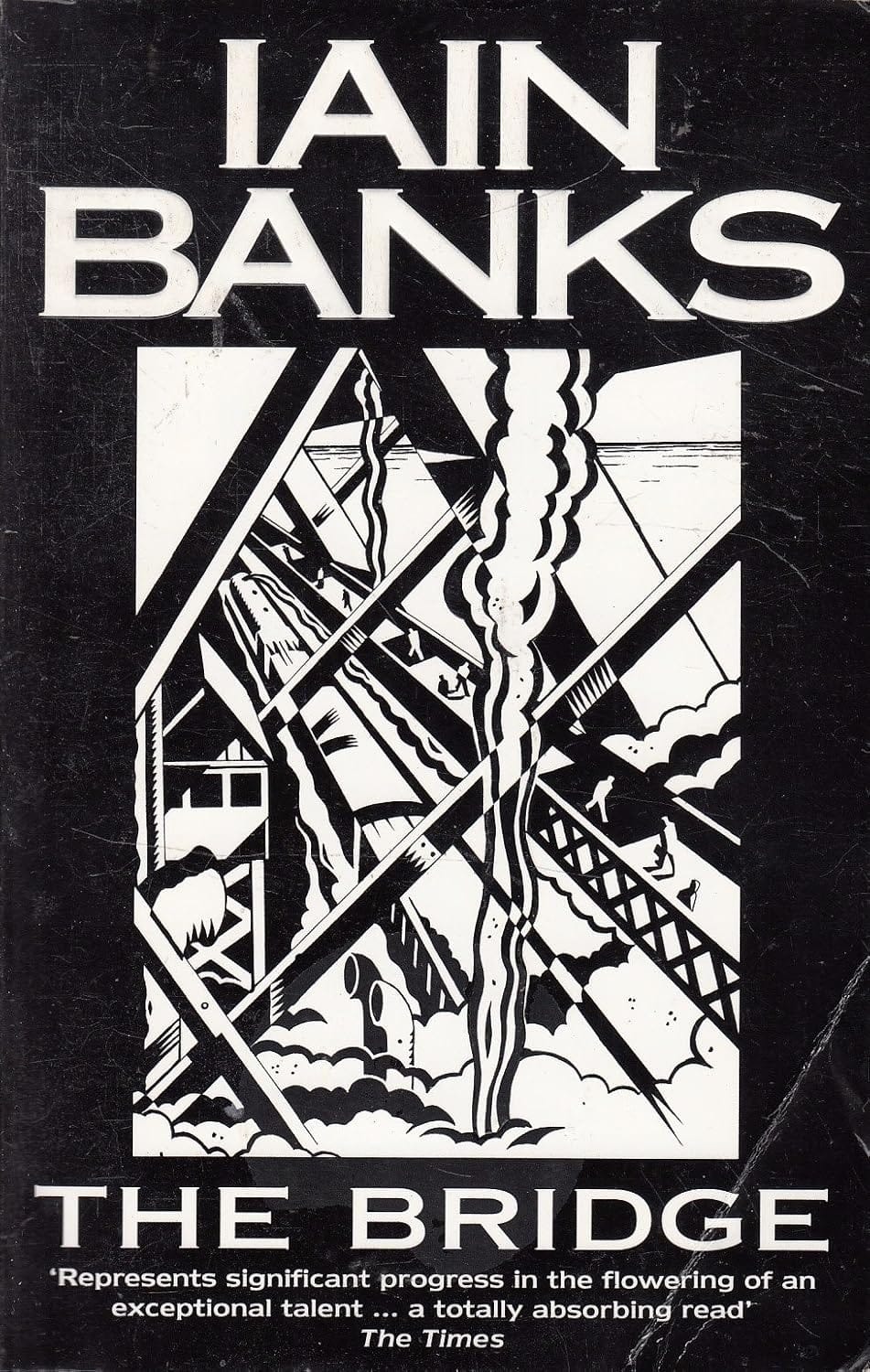
The Bridge. The Beach. The Corridor. The Room. The Elevator.
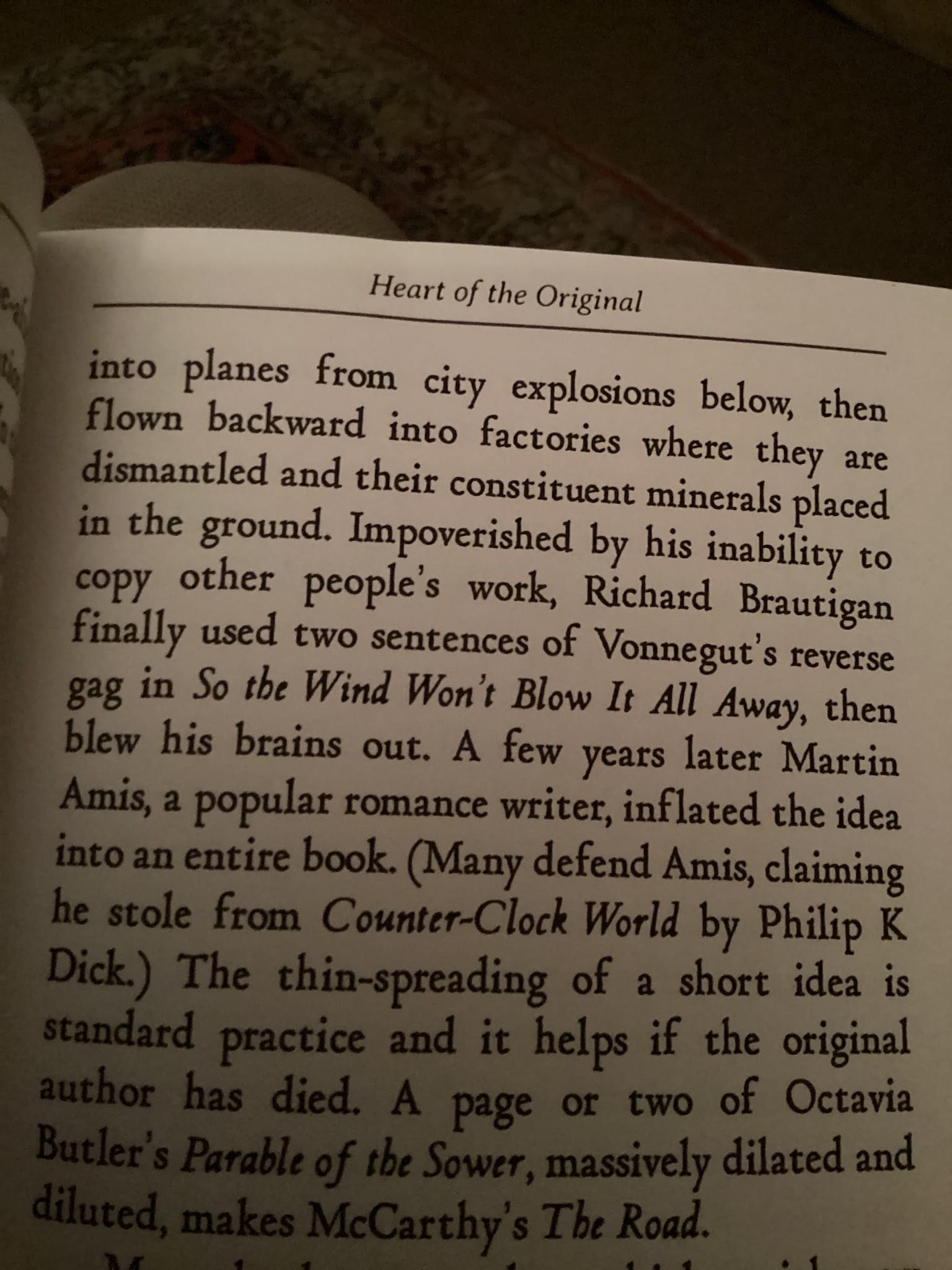
Uh, The Road, I guess.
in my day we called no-clipping astral projection and were done with it
ITEM
The Child-Stealer by Penelope Shuttle (OUP, 1983)
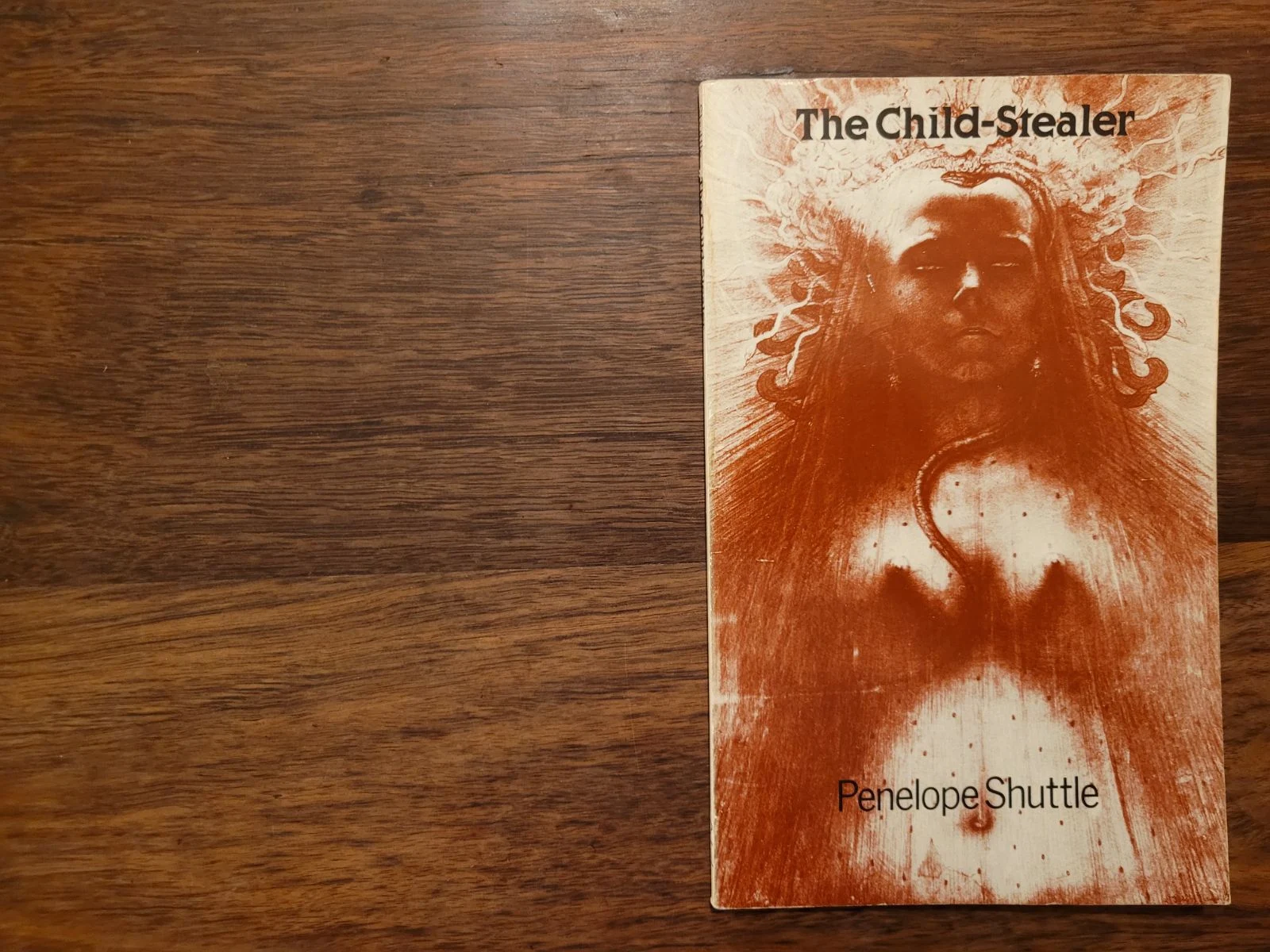
Was Lillith Child-Stealer, woman one, moulded from the clay with the desire to ride the first man's dick from on top, so she could really feel it? Was that in the design, from the first day, or before? Or was it something she worked out herself over time, after so many languid unfulfilments in the dawn garden? Adam, brain still in the mud, lying flat and flapping, undoing himself through orgasm, wishing to become a ball again. Being a symbolic function, a story-fairy, she could see his desire all the ways from its idle scratching to full borne fruit. She lies back and thinks of the serpent, wicked leer and shapely thighs,
She never fell pregnant, or if she did, did away with it, unwilling to honour his hapless seed. When she tries adding spice to their grassy bed, he reacts with horror and complains to God.
Banished. Spider lady Lil is forgotten by the Powers and his pets, and hovers at the edges of the garden, surviving on berries from the ripe hedge. She becomes a bird, a flock of dinosaurs. She knows there was something there at the top of the garden she never quite got, and finds it in the creatures she meets on the fringes. Angels, djinn, maybe that charming snake again, once or twice. She goes on top, tells them what to touch, and they love her for it.
Her replacement, the husband's tampered clone, spreads her legs and out pours an endless waterfall of self-righteous sadists and their forgettable, dullard victims. But she was always first and knows all their names, their sex. Speaks to them in the red womb, tells them what they'll be. Her anger pierces them, making her their mother too, in her way. On the compass of her senses.